Beyond Reassurance: A Parent's Checklist for a Productive Maths Parents' Evening

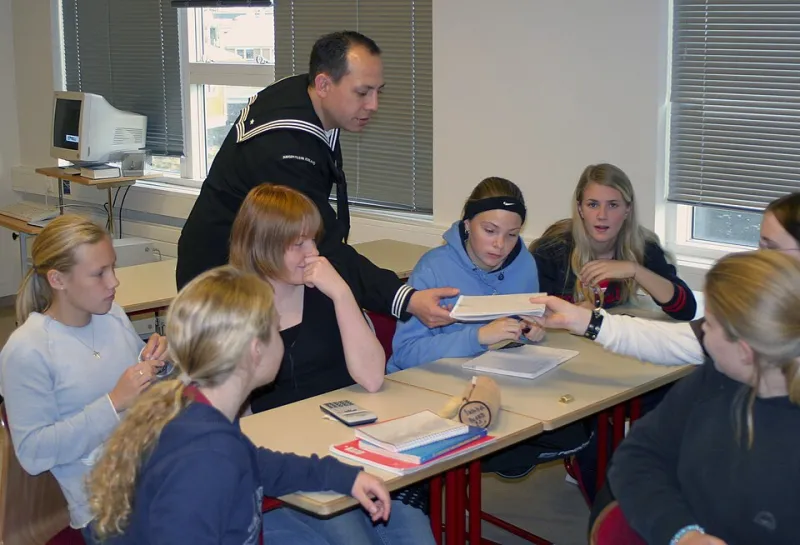
Photo: Dquai, CC BY-SA 4.0, via Wikimedia Commons
Parents' evening is a short conversation with a lot riding on it. Many parents arrive with one broad question: 'Is my child doing OK?' Teachers understand the concern, but the question is difficult to answer usefully in five minutes. 'Doing OK' can mean coping, meeting expectations, making progress, or simply not causing concern. A more specific question produces a more specific answer, and a more specific answer is more likely to lead to action.
The aim is not to interrogate the teacher or to turn a brief appointment into a full review. It is to leave with two or three clear facts and one realistic next step. The following questions are designed for UK parents of secondary maths students, though they can be adapted for primary settings.
Before the appointment
Look at the exercise book or online homework platform before you go. Note the topics covered recently and any repeated corrections. You do not need to understand every method; you only need enough context to ask a focused question. Decide in advance whether your priority is fluency, confidence, homework habits or additional support. A short list of two or three questions is more effective than a long one.
Ten questions worth asking
1. Which specific skills is my child fluent in, and which are still shaky?
Fluency means more than knowing a method once. It means being able to recall number facts, apply procedures accurately and choose an appropriate method without prompting. Ask for an example. A teacher might say that your child can solve linear equations but loses accuracy when negative numbers are involved. That is more useful than a general comment about confidence.
2. What misconception is currently holding my child back?
Misconceptions are not random errors. They are consistent, understandable mistakes, such as treating multiplication as always making a number larger, or adding fractions by adding numerators and denominators. Once named, a misconception can be addressed directly. Ask how it is being tackled in class and what you can do at home.
3. How does my child cope when a problem is not immediately obvious?
GCSE and A-level questions increasingly require students to choose a method rather than follow a prescribed one. Ask whether your child persists, gives up, or waits for help. This tells you more about exam readiness than a single test score.
4. How much time should maths homework take, and how much should be independent?
Homework habits vary widely. Ask what the school expects, how long it should take, and what your child should do if stuck. A sensible department will have a clear policy on attempting the work before seeking help. If homework regularly takes far longer than expected, that is worth exploring.
5. What should my child do if they are stuck at home?
This is a practical question with a practical answer. Should they write down the difficulty and move on? Use a worked example? Attend a clinic? Knowing the procedure prevents wasted evenings and reduces anxiety.
6. How can I check that homework is being completed, without doing it for them?
Parents often feel they should be able to explain the maths. Usually they do not need to. Ask what a useful parental check looks like: completed questions, corrected answers, a note of difficulties, or a short online quiz. The teacher can tell you what to look for.
7. Is my child receiving any additional support, and what is the target of that support?
Intervention should have a clear purpose. It might focus on times tables, algebraic manipulation, exam technique or confidence in problem-solving. Ask what the target is, how progress is measured and when the support will be reviewed. If your child is not receiving support, ask whether any is available or whether the current need is better met through classroom adjustments.
8. What is the single most useful thing we can do at home this term?
This question forces prioritisation. The answer might be practising mental arithmetic for ten minutes a week, reading through corrected work, or ensuring that homework is attempted before the deadline. A single, specific action is more likely to be sustained than a vague instruction to 'do more maths'.
9. How will we know whether things are improving?
Ask what evidence the teacher will use. It might be a topic test, a mock exam, a piece of classwork or a homework record. Agree a rough timescale for checking again, whether through the school's reporting system or a brief email. Progress is easier to recognise when the measure is clear.
10. What is the best way to follow up if I have another concern?
Schools have different procedures for contacting subject teachers. Ask whether email, phone or the school portal is preferred, and what information you should include. This avoids messages being lost or sent to the wrong person.
After the appointment
Parents' evening is most useful when it leads to a short, realistic plan. Write down the key points while they are fresh. Share one or two of them with your child, using the teacher's language rather than translating them into a lecture. For example, 'Your teacher says negative numbers are the main thing to practise' is clearer than 'You need to try harder in maths'.
It is also worth remembering that teachers are often seeing many families in one evening. A focused question is a kindness to them as well as to you. It signals that you are interested in specifics, not just reassurance.
A productive parents' evening does not require a long conversation or a detailed knowledge of the curriculum. It requires a few precise questions, a willingness to hear the answer and one agreed next step. That is a better outcome than a polite exchange that leaves everyone reassured but no clearer about what happens next.