Evidence, Not a Verdict: Turning a GCSE Maths Mock Into a Working Revision Map
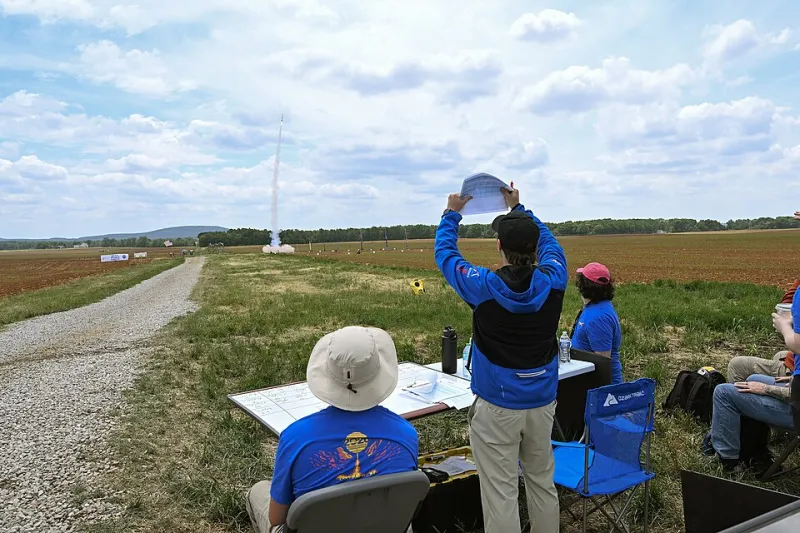
Photo: NASA Marshall Space Flight Center / NASA/Charles Beason, Public domain, via Wikimedia Commons
Every November and December, thousands of Year 11 students sit a mock GCSE Maths paper, collect a mark and immediately ask the same question: what grade is that? Teachers will answer as helpfully as they can, and knowing how a mock compares with a target grade has its uses. Yet the percentage on the front cover is the least informative part of the script. A mock does not deliver a verdict; it produces evidence about how a student thinks under timed conditions. Read carefully, that evidence becomes a revision map for the months that remain.
The trouble with a post-mortem
A post-mortem explains a death. It looks backwards, assigns causes and closes the file. Many students treat a returned mock in exactly this way: they flick through, wince at the red pen, note the total and put the paper in a folder. The same errors then reappear in February.
A revision map does something different. It asks not what went wrong, but what each lost mark is evidence of, and which specific action would stop it recurring. Two students can both drop twelve marks and need entirely different work over the next six weeks.
Five kinds of lost mark
Almost every mark lost in a GCSE Maths paper falls into one of five categories. Sorting them is the central task.
Knowledge gaps. The student does not know the fact, formula or technique. A Higher tier candidate who cannot recall the quadratic formula, or a Foundation candidate who cannot convert between fractions and decimals, has a gap. These marks require teaching or re-teaching, not more practice of the same kind.
Method errors. The student knows the topic but applies the wrong procedure, or misjudges which approach a question demands. Writing a ratio as a fraction in the wrong order, or reaching for Pythagoras where trigonometry is required, are method errors. They are usually fixable in a single focused session, provided the student can explain why the correct method is correct.
Arithmetic slips. The thinking was sound; the execution was not. A dropped negative sign, a mis-copied number, seven eights answered as fifty-four. These are rarely cured by doing more questions of the same type. They are cured by changing habits: one line per step, an estimate to check against, and work that can still be read at the bottom of the page.
Timing and pressure. The student could do the question at home but not in the hall. Common signs are a blank final page, deteriorating handwriting in the last twenty minutes, or a correct method abandoned halfway. Time is a skill, and it can be rehearsed.
Misread questions. The mathematics was within reach, but the student answered a slightly different question from the one printed: rounding to two decimal places instead of two significant figures, giving the total when asked for the difference, ignoring the word 'hence'.
Colour-coding the script
A simple system works well. Take four coloured pens or highlighters and mark each lost mark on the paper:
- one colour for 'I did not know this'
- one for 'I knew it but chose the wrong method'
- one for 'I knew it and slipped'
- one for 'I ran out of time or misread the question'
The pattern is often surprising. Many students discover that the largest single block is not knowledge at all, but slips and misreads, which are far cheaper to fix.
From pattern to plan
Once the script is coded, tally the marks by category and by topic. A typical profile might read: twelve marks lost in algebra, of which eight were method errors on solving equations with unknowns on both sides. That is a precise instruction: two sessions on that skill, using past paper questions, is likely to recover several marks. By contrast, 'revise algebra' is not an instruction at all.
Build the plan around three questions:
- Which two or three topics account for the greatest number of lost marks?
- Within those topics, is the problem knowledge, method or execution?
- What will the student actually do in the next fortnight, and how will they know it has worked?
The last question matters most. A plan without a check is a wish. Students should re-attempt the original questions from a blank page a week or two after the revision. If the same errors recur, the diagnosis was wrong and the approach should change.
Timing deserves its own file
Time pressure is easily overlooked because it leaves no written trace. Look at the paper as a whole: where does the handwriting deteriorate? Which questions were attempted in the final ten minutes?
A useful rule of thumb at GCSE is roughly one mark per minute, finishing the earlier, shorter questions comfortably ahead of that pace in order to bank time for the longer problems at the back. Students can rehearse this at home by sitting a full paper with a visible clock and noting the time at the end of each page. Two or three such rehearsals usually do more for confidence than a dozen untimed worksheets.
How parents can help without re-teaching
Parents are often unsure what to do with a returned paper, particularly when the mathematics looks unfamiliar. The most useful contribution is not instruction but questioning, kindly delivered. Ask which questions the student expected to get right and did not. Ask which ones they would now do differently. Ask what the teacher said. Then help them protect time in the week for the two or three priorities identified.
It is worth resisting the urge to compare the mock mark with a target grade in every conversation. A November mock is a snapshot taken early in the course; the summer examination is what counts, and a great deal of teaching is still to come.
Keep one sheet, not a folder
The final product of this analysis should be a single sheet of paper: the two or three priority topics, the specific skill within each, the dates on which they will be revisited, and a note of the re-test result. Everything else can go in the folder. A student who can name their three priorities and explain why they chose them is already revising more intelligently than one who simply works through another paper from question one.
If the pattern is unclear, a short conversation with the class teacher usually settles it. Teachers see dozens of these scripts and can confirm in a minute whether a difficulty is widespread or particular to one student. The mock has done its job once it has told you what to do next.