Before the Method: Constructive Opening Moves for Stalled GCSE Maths Questions
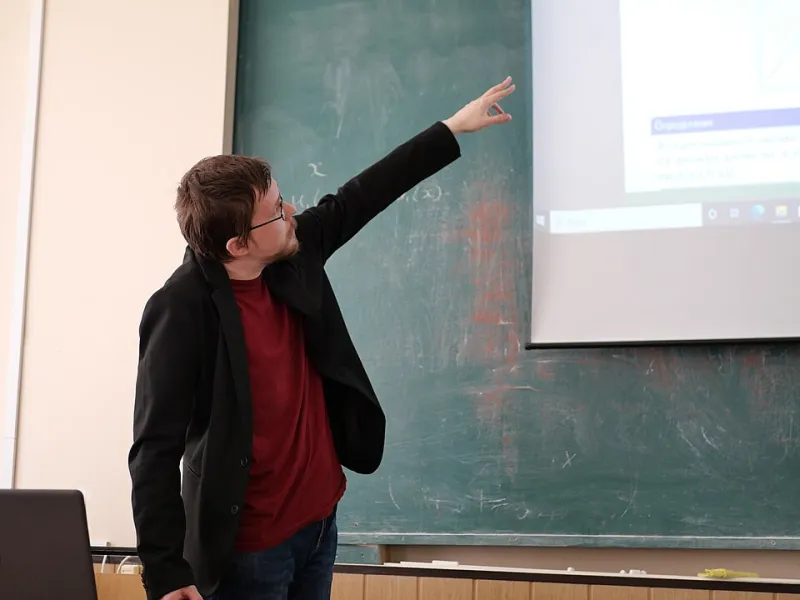
Photo: English: Andrew Krizhanovsky Русский: Андрей Крижановский, Public domain, via Wikimedia Commons
There is a particular kind of silence in an exam hall that follows the reading of a question nobody recognises. The words are familiar, the numbers are visible, but the route from one to the other has disappeared. In that moment, the instinct is often to wait for the full method to arrive before writing anything. Waiting, however, is rarely productive. GCSE maths papers reward evidence of thought, and a structured beginning can turn a stalled question into a workable one.
The moves below are deliberately low-risk. None commits a student to a complete solution, and each can be abandoned if it leads nowhere. Their purpose is not to guarantee the answer but to break inertia, make the question more legible and, where possible, place method marks within reach.
1. Record what the question gives you
A useful first act is to copy the given information into a compact form. Write down the values, units, labels and constraints. If a shape has a radius of 7 cm and a height of 12 cm, record r = 7 and h = 12. If a question states that a number is increased by 15%, write the multiplier 1.15 beside it. If a diagram carries equal angles or parallel lines, mark them.
This is not busywork. It reduces the amount of information the student must hold in mind while searching for a method. It also exposes details that are easy to overlook under pressure, such as a unit that needs converting or a condition that limits the answer. The student may not yet know what to do with the information, but the question is now less abstract.
2. Draw the situation, even roughly
Geometry and measures questions almost always benefit from a sketch, but the value of a diagram is not confined to those topics. A number line can clarify an inequality. A table can organise a sequence. A simple bar or arrow can represent a ratio. The drawing need not be accurate or beautiful; it needs only to show the relationships the question describes.
Annotating a diagram is often the moment when a hidden relationship becomes visible. A right angle suggests Pythagoras or trigonometry. Two equal lengths suggest an isosceles triangle. A line crossing parallel lines suggests alternate or corresponding angles. Even a rough sketch can prevent a student from applying a formula to the wrong side or angle.
3. Translate the question into your own words
Many GCSE questions are lost not through mathematical difficulty but through misreading. Before choosing a method, it helps to identify the command word and restate the task plainly. If the question says “show that”, the target is given and the work must connect the information to it. If it says “estimate”, exact calculation is not required. If it says “compare”, a conclusion is needed, not just two separate results.
A student might write: “I need to find the total cost after two discounts” or “I need to prove the expression is always even”. This small act of translation reveals whether the question is asking for a value, a proof, a comparison or an explanation. It also makes it harder to answer a slightly different question from the one actually printed.
4. Try a smaller or simpler case
When a general question feels impenetrable, a particular example can provide a foothold. For a sequence, calculate the first few terms. For an algebraic proof, test a small number to see what the statement is claiming. For a complex probability or ratio problem, reduce the quantities to manageable figures and observe the structure.
Suppose a question asks students to show that the difference between the squares of two consecutive odd numbers is a multiple of 8. Testing 1 and 3 gives 9 − 1 = 8, which confirms the pattern and suggests how to represent the numbers algebraically. The test is not the proof, but it makes the proof less mysterious. A simpler case can also reveal whether a proposed method is worth pursuing before time is invested in it.
5. Start a partial calculation and label it
If any sub-part of the question can be calculated, calculate it. Find the area of one face, the total of the given values, the gradient between two points or the probability of a single event. Write a short label beside the result so that the examiner can follow the purpose of the calculation.
This move is particularly valuable because GCSE mark schemes often award method marks for correct intermediate steps, even when the final answer is wrong. A student who writes the relevant formula and substitutes known values has already demonstrated some understanding. If the substitution does not lead anywhere, the student has still learned something about why that route may not fit. Starting a partial calculation is not a commitment to a flawed method; it is a way of generating information.
Why these moves matter under pressure
The common thread is that each move externalises thought. A frozen student is often trying to solve the entire question silently, holding every condition and possibility in working memory at once. Writing, drawing or restating reduces that load. The question becomes an object that can be examined rather than a threat that must be guessed.
These moves also protect against the worst outcome in an exam: an entirely blank response. A blank answer cannot earn credit. A response containing relevant given information, a diagram, a formula or a partial calculation may earn method marks and will certainly make the question easier to resume if time allows. Examiners mark what is on the page, not what a student intended to write.
A sensible time limit
Low-risk moves should not become a hiding place. A reasonable approach is to spend thirty to sixty seconds on one or two moves, then decide whether progress is being made. If the question remains opaque, move on and return later. The opening moves have still done useful work: they have prepared the ground for a second attempt and left evidence of method.
In the 2026 GCSE maths examinations, students will meet questions that do not announce their method. That is part of the design. The skill being tested is not instant recognition but disciplined thinking. Starting with a small, safe action is often enough to turn a blank page into a route.