The Marks Between the Lines: Layout Habits That Help GCSE Examiners Follow Your Maths

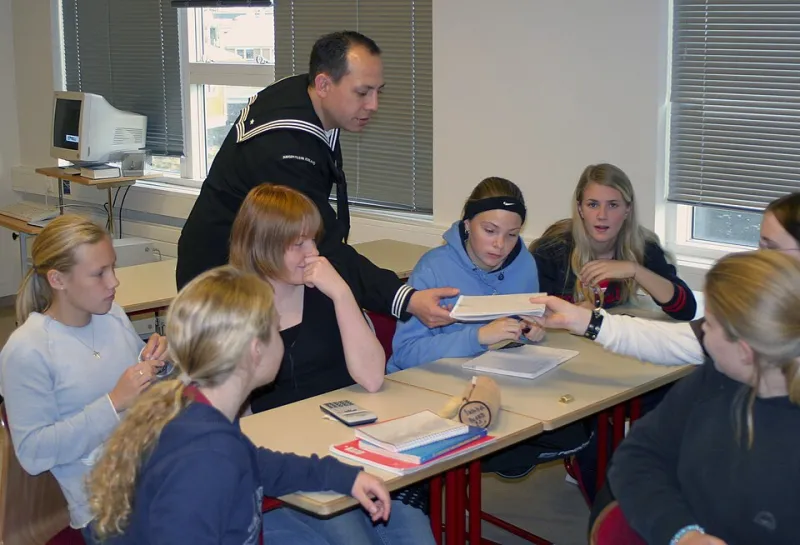
Photo: Sandwell Council, CC BY-SA 2.0, via Wikimedia Commons
Clear working is not a cosmetic extra in GCSE maths. It is the medium through which a student's method becomes visible to an examiner. Two candidates may reach the same answer, or make the same small slip, and receive different credit because one has left a readable trail and the other has left a page of compressed fragments. This is the legibility premium: not a reward for handwriting, and certainly not a reward for neatness for its own sake, but a recognition that method marks depend on evidence that another person can follow.
What examiners need to see
Examiners are not trying to reconstruct a candidate's thought process from guesswork. They need to see where a calculation began, what substitution was made, how an intermediate result was obtained and how the final answer connects to the question. In a multi-step problem, the working is the argument. If two methods are interleaved, if a correction is ambiguous, or if a diagram has no labels, the mathematical evidence becomes weaker even when the candidate understood the topic.
This matters most in questions where method marks are available. An answer alone may earn credit in some cases, but it does not always demonstrate the required skill. A calculator paper is a particular trap: a correct displayed value with no recorded calculation can leave an examiner unable to award a method mark that the student would otherwise have earned. The same principle applies to algebra, geometry and problem-solving questions. Method marks are not a reward for effort; they are a judgement about visible mathematical evidence.
Five habits that build clarity
The aim is not to produce a fair copy. It is to make the working easy to audit while it is being written. These habits can be practised in ordinary homework, without adding a separate revision session.
1. Use a working column and an answer line. Treat the page as having zones: question number at the left, working in the main column, and a clear final answer at the right or beneath. A boxed or underlined answer is not required by every exam board, but a consistent answer line helps both the student and the examiner. In homework, fold the page or draw a margin if the printed layout is cramped. The habit should feel ordinary before it is needed under pressure.
2. Put one mathematical step on each line. Long chains of calculation are difficult to follow, especially when a sign error occurs halfway through. Aligning equals signs and indenting continuation lines makes the structure visible. If a line is becoming crowded, start a new one rather than squeezing working into the margin. This is particularly useful in solving equations, rearranging formulae and multi-stage arithmetic.
3. Define variables and label diagrams before the algebra starts. A line such as 'let x be the number of adult tickets' takes seconds and prevents ambiguity later. In geometry, label angles, lengths and units on the diagram as they are found. An examiner should not have to infer what a symbol represents or which side a calculation refers to. Clear definitions also help the student avoid losing track of the problem.
4. Show the substitution before the calculator result. Write the formula, substitute the values, then give the result. For example, show the area calculation as formula, substitution and answer rather than only the final value. This is especially important in compound measures and trigonometry. It gives the examiner a method to credit and gives the student a chance to spot a wrong button press.
5. Adopt one correction convention. Mistakes are normal. Ambiguous corrections are not. A single line through an error, with the replacement written below, is clearer than scribbling over the original or overwriting digits. If a whole method is abandoned, mark it as not used and begin again. Make the final answer unmistakable. The examiner should never have to decide which of two answers is intended.
The time objection
Students often believe that clear layout costs time. In practice, it usually saves time: fewer repeated calculations, fewer lost lines and less frantic crossing out. A useful check is to pause for ten seconds after a multi-step question and ask whether another person could follow the working without asking a question. If the answer is no, the candidate has probably left marks in a vulnerable position.
A short pre-submission check
Before moving on, the student can check four things: Is the question number clear? Is the working in a sensible order? Are units and labels present where needed? Is the final answer easy to find? This is not a demand for perfection. It is a small quality-control step that protects the mathematics already done.
Clear layout will not replace mathematical knowledge, and no examiner awards marks for presentation alone. But in a subject where method matters, legibility is part of communication. The legibility premium is earned quietly, in homework, by students who make their reasoning easy to read.