Reading the Reference: A Purposeful Approach to GCSE Maths Formulae

In a GCSE maths exam, a formulae page can feel reassuring. It offers a visible store of relationships that might otherwise need to be recalled from memory. That reassurance can, however, become a delay. A sheet of formulae does not replace the judgement needed to recognise which relationship a question is asking for, nor does it remove the need to understand what the symbols mean in context. It works best when students have rehearsed how to read it before the exam, not when they meet it for the first time under timed conditions.
What the sheet can and cannot do
A formulae sheet supplies expressions. It does not supply interpretation. Students still need to identify the quantities in a question, note the units involved, decide which relationship connects them and check whether the result is reasonable. Exam boards differ in what they provide and in the rules that apply to the examination, so students should check the arrangements for their own specification and papers. The central point is consistent: the sheet is a reference, not a decision tree. It can confirm a relationship; it cannot choose the method.
Three habits that cost marks
Searching mid-question
A common pattern is for a student to begin a question, lose confidence halfway through and then scan the formulae page for something familiar. Under time pressure, the first familiar formula can look like the right one. The search also breaks the flow of the question and can leave the student with a copied expression but no clear plan. A brief orientation at the start of the paper is more useful than repeated hunting later. Students should know where the main groups of formulae sit, then return to the page with a specific purpose: to confirm a relationship they have already identified.
Copying without substituting
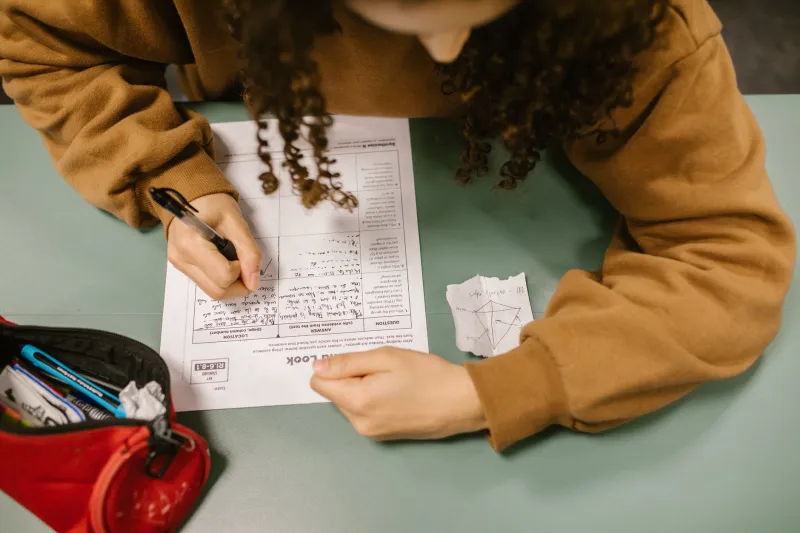
Copying a formula onto an answer line may feel productive, but it earns little on its own. The useful move is to translate the formula into the particular question. Students should write the formula, then immediately write the known values beneath the matching symbols. They should identify the unknown before calculating. This turns transcription into substitution and gives the examiner visible method. It also exposes mismatches early: if the values do not fit the symbols, the formula may not be the right one.
Ignoring symbols and units
A formula is a statement about quantities, not a string of letters. Students should be able to say what each symbol represents in the question and what unit the answer will carry. Similar formulae can otherwise blur together: area and circumference, speed and density, simple and compound interest. Units act as a check. If a question gives time in minutes but the formula expects hours, the substitution must reflect that. If an answer for a length comes out in square centimetres, something has gone wrong before the final line.
A short rehearsal routine for lessons and home
The aim is not to memorise the sheet. The aim is to make it familiar, usable and subordinate to reasoning. A short routine, repeated little and often, is more effective than a single long session.
Step 1: Find
Give the student a small set of prompts, such as the area of a trapezium, the sine rule or the formula for compound interest. The student locates the relevant formula on the sheet and points to it. This is not a memory test. It builds a mental index of the page.
Step 2: Say
Ask the student to explain what each symbol represents and what unit the result would take. A parent can do this without teaching the mathematics: the question is simply what each letter stands for here. If the student cannot explain a symbol, the formula is not yet ready to use.
Step 3: Substitute
The student writes the formula, places the known values underneath the correct symbols and identifies the unknown. Calculation can wait. The purpose is to practise the translation from question to expression.
Step 4: Check
Finally, ask whether the formula fits the context, whether the units are consistent and whether the answer is plausible. This step is where the sheet becomes part of exam technique rather than a substitute for it.
Teachers can use the routine as a starter or a revision station. Parents can use one question at the kitchen table. The sheet should remain visible during practice, but it should not be the first move. The first move is to name what the question is asking.
In the exam room
A sensible approach is to spend a short time at the start of the paper noting the layout of the formulae page, without trying to memorise it. In each question, students should read the request carefully, identify the quantities and units, decide on the relationship and then consult the sheet if needed. If a formula cannot be found quickly, it is usually better to move on and return than to spend a long time searching. When the formula is used, the substitution should be written clearly so that method marks can be awarded even if the final arithmetic slips.
What parents can do without teaching maths
Parents do not need to know every formula. They can ask where the child would look, what each letter means and what unit the answer should have. They can encourage the child to explain the substitution before calculating. They can also discourage the habit of reaching for the sheet before reading the question. These small prompts reinforce the same message: the formulae page is a working reference, and its value depends on the thinking that surrounds it.
For 2026 candidates, the practical lesson remains the same. Students who can locate, interpret, substitute and check will use the formulae sheet as support. Those who treat it as a last-minute panic button will find that it adds time rather than reduces it. Rehearsal turns the page from a crutch into a tool.